


I’ve always had a soft spot for Zinfandel. It was never the most refined or restrained, but that was always part of its charm—loud, unapologetic, dripping with fruit and confidence. No grape embodies the American love for the bold and brash quite like Zin, a wine that, for better or worse, became synonymous with high alcohol and over-the-top ripeness. It was a gateway, matching the intensity of my developing palate when I first began dabbling into wine. But just as my taste has evolved, so has Zinfandel. A new generation of winemakers is proving that it can be more than just a fruit bomb—showing restraint, structure, even age-worthiness. And if you think Zin’s story begins and ends in California, think again. This grape has lived many lives, with roots that stretch far beyond the Golden State.
The same grape that fuels backyard BBQs in America has a more ancient, aristocratic past in Croatia and another wildly ripe, sun-drenched twin in southern Italy. Meet Zinfandel, Primitivo, and Tribidrag—the same grape, three radically different identities.
A grape unlike any other
Before we dive into Zinfandel’s identity crisis, let’s talk about the grape itself—because it’s a bit of a problem child. The berries are notoriously uneven in their ripening, meaning that in any given cluster, some grapes may be underripe while others are bursting with sugar. This presents a challenge for winemakers: pick too early, and you risk green, harsh tannins; wait too long, and you’re looking at sky-high alcohol levels and jammy, overripe fruit. For those aiming to produce a balanced wine, this means careful handling of the berries on the vines—painstakingly tedious work.
Because of this, Zinfandel has long been misunderstood and, frankly, under appreciated. In the late 19th and early 20th centuries, some speculated it was a native grape, uniquely American. This, of course, was incorrect—Vitis vinifera, the species responsible for nearly all fine wine, isn’t indigenous to the Americas. But Zin thrived in California’s climate, and for a time, its true origins were a mystery.
Another quirk? Thin skins and tight clusters make it prone to rot, meaning it requires careful vineyard management. And yet, despite these challenges, Zinfandel has persisted—reinventing itself time and time again, adapting to different soils, climates, and winemaking philosophies.
So how did it go from an obscure European grape to California’s most famous red? The journey starts in Croatia.
Tribidrag: The forgotten king of the Adriatic
Before Zinfandel became an American icon, before Primitivo found its fame in Italy, there was Tribidrag, the ancient Croatian ancestor of them all. Its name, first documented in the 15th century, hints at its nature—'drag' comes from an old Slavic word meaning ‘early,’ referring to its tendency to ripen faster than its peers.
In its heyday, Tribidrag was a noble grape, enjoyed by aristocrats and written about in historical documents as far back as the Venetian Republic. But history wasn’t kind. War, phylloxera, and shifting wine trends pushed Tribidrag to the edge of extinction. Phylloxera, for the uninitiated, is the microscopic root louse that wiped out most of Europe’s vineyards in the late 19th century, forcing winemakers to regraft vines onto disease-resistant American rootstock. While some grapes bounced back, Tribidrag was nearly lost—kept alive only by a handful of vineyards along Croatia’s Dalmatian coast.
Then came the bombshell discovery: Zinfandel was not an American original—it was Tribidrag all along. In the 1990s, DNA profiling confirmed that California’s beloved Zin and Italy’s Primitivo were actually the long-lost offspring of this nearly extinct Croatian grape.
But here’s the kicker—Tribidrag doesn’t taste like either of them.
Terroir & style
Croatia’s Dalmatian coast is a brutal place to grow vines. The soils are rocky, the climate is harsh, and the vineyards cling to steep slopes overlooking the Adriatic. But struggle makes for complexity. Where Zinfandel leans into plushness, and Primitivo into ripeness, Tribidrag is more structured, more mineral-driven, more serious.
Flavors: Dark berries, dried fig, Mediterranean herbs, black pepper, and an unmistakable salty edge that tastes like the sea breeze itself.
Bottles to try:
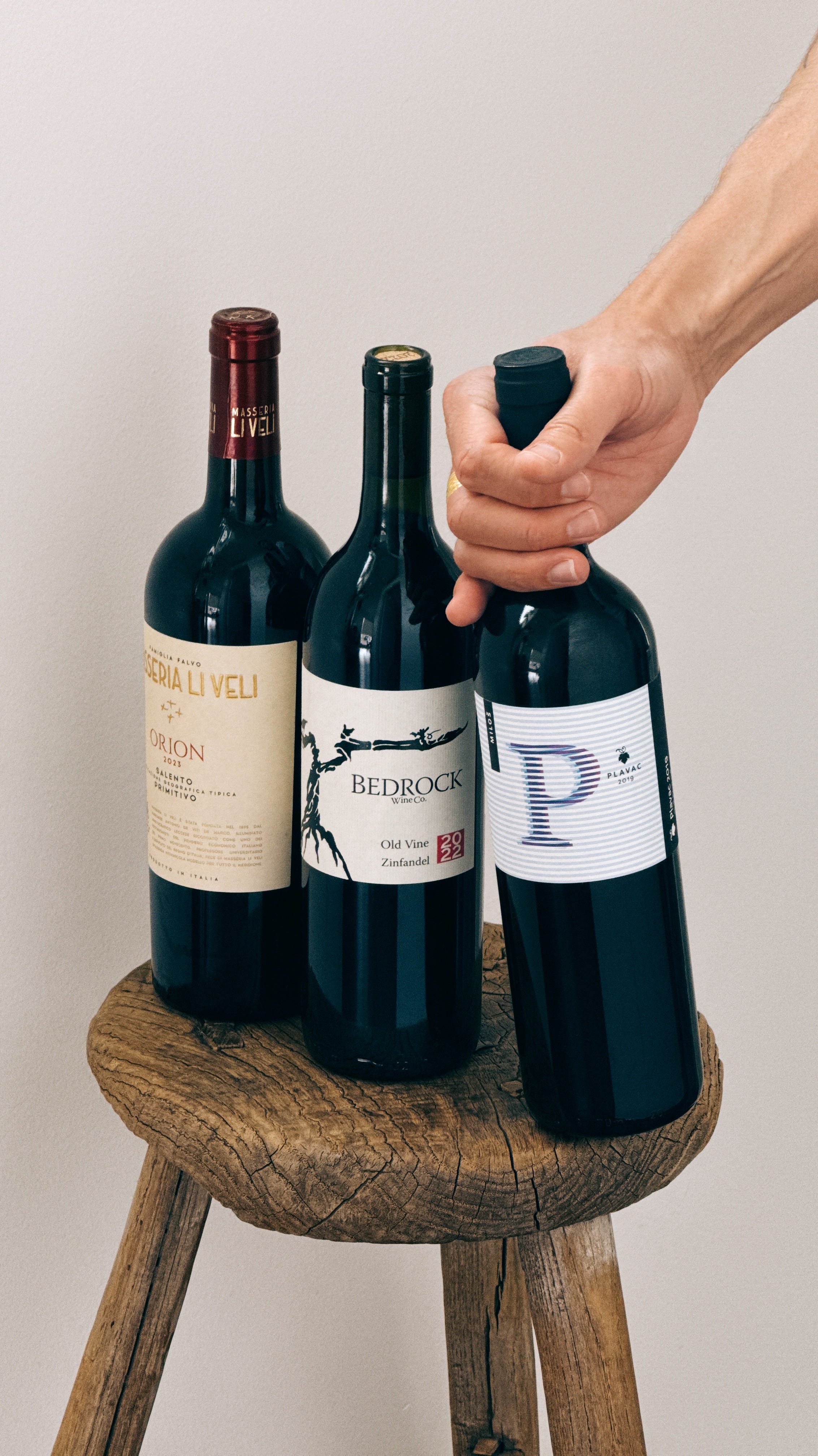
Miloš Plavac Pelješac Peninsula Croatia – Earthy and structured, with a mineral backbone
Saints Hills 'Black' Crljenak – A full-bodied, serious take on Croatia’s native Zinfandel
Bibich Bas de Bas Crljenak Kaštelanski – A rare, elegant version with aging potential
Primitivo: The sun-drenched, ripe & reckless twin
If Tribidrag is the old soul, then Primitivo is the Italian diva—you can sense its gravitas the moment it’s poured into a glass.
Brought to Puglia in the 18th century, it quickly became a local favorite. The name “Primitivo”—once again—refers to its tendency to ripen early—a lifesaver in the hot, dry vineyards of southern Italy. Puglia, located in the heel of Italy’s boot, is famous for its rolling hills, whitewashed villages, and some of the most stunning beaches in Europe. This region doesn’t do “delicate.” Wines here are bold, ripe, sun-drenched, and unapologetically generous.
Terroir & style
Puglia’s climate is intense: long, sunbaked summers, low rainfall, and cooling Adriatic breezes. This means Primitivo wines develop ultra-ripe fruit flavors, plush textures, and higher alcohol.
But not all Primitivo is created equal. While some producers chase sheer power, others focus on balance, letting acidity and structure shine through. The best examples combine ripeness with freshness—big and velvety, but never flabby.
Flavors: Black cherry, plum jam, cocoa, baking spices, and a touch of Mediterranean wildness.
Bottles to try:
Masseria Li Veli "Orion" Primitivo – A lush, fruit-forward example of classic Primitivo
Fatalone Primitivo Gioia del Colle – A more structured, elegant style, proving Primitivo isn’t just about power
Polvanera 17 Primitivo – A high-altitude take, showing surprising freshness and grip
Zinfandel: The Wild West rebel that won’t be tamed
And then we come to Zinfandel—the cowboy, the risk-taker, the American original (even though we now know it’s not).
While there continues to be much debate as to how the grape made its way to the West Coast, it’s believed to have been brought to California in the mid-1800s, and Zinfandel exploded during the Gold Rush. Miners and settlers fell in love with its bold flavors and easy-drinking nature. It became California’s wine—the backbone of old-vine field blends and, later, one of the most recognizable names in American viticulture. But, like California itself, the wine has experienced its own ups and downs. Prohibition nearly brought it to its demise, though some vineyards were maintained to produce sacramental wine for the church.
It’s been everything from a rustic field wine to a sweet, blush-colored abomination (looking at you, White Zinfandel). Then came the 1990s, when big, boozy, high-alcohol Zins became cult favorites. But today? We’re seeing a new wave—one that respects balance, structure, and terroir.
Terroir & style
California is vast, and Zin expresses itself differently depending on where it’s grown:
Sonoma & Napa: More structured, age-worthy, with spice and elegance
Lodi: Ripe, fruit-driven, full-throttle Zin
Paso Robles: Bold, juicy, sometimes downright hedonistic
Flavors: Blackberry jam, cracked pepper, tobacco, and vanilla from oak aging.
Bottles to try:
Bedrock Wine Co. Old Vine Zinfandel – A serious, terroir-driven take on Zin
Sandlands Zinfandel – A cult favorite, leaner, fresher, and redefining what Zin can be
Ridge Geyserville – One of the most elegant, age-worthy Zinfandels on the market
Final showdown
Zinfandel has never played by the rules. It’s been a noble wine, a working man’s drink, a cult classic, and a misunderstood misfit. It’s thrived in unexpected places, endured near-extinction, and reinvented itself at every turn. If there’s one thing this grape refuses to be, it’s predictable.
And maybe that’s the real magic of Zinfandel—of Tribidrag, of Primitivo. It doesn’t belong to just one place, one identity, or one style. It’s a survivor, a frontier traveler, a shape-shifter in a bottle.
So, where do you begin? That depends on what kind of drinker you are. Want history in a glass? Start with a rugged, sea-kissed Croatian Tribidrag. Looking for sun-drenched, bold, and effortless charm? Primitivo’s got you covered. Craving pure American power? Zinfandel is calling.
But here’s the real question—who wore it best? The only way to know is to pour a glass and decide for yourself.
Have you tried the Zin from Sky on Mt Veeder? One of the most compelling reds I tried last year. Zin's pretty hit-and-miss with my students at all levels. They're a bit wary of its often boozy nature. But I enjoy grappling with it whenever it retains a bit of zestiness.
I used to think Zin was not good because of cheap boxed White Zinfandel I had at parties in. college. In recent years though some of my favorite wines have been Zins. One that I order often from Naked wines is very affordable, Sharon Weeks Cattoo Lodi Reserve Zinfandel 2020.