


Armani just shot their latest campaign on VHS. Not some cutting-edge camera capable of capturing every minuscule detail in 8K, but an old VHS camcorder—the kind my dad used to fumble with at birthday parties, its red recording light steady and patient. The footage stutters and bleeds, colors washing into each other like watercolors in rain. Deliberately imperfect, and all the more beautiful for it.
It’s tempting to dismiss this as nostalgia bait, another calculated play for Gen Z’s affection. But I think it signals something deeper. While we choke on what everyone has started calling “AI slop”—that uncannily smooth, technically flawless yet soulless content flooding every corner of the internet—there’s a countercurrent forming. We’re developing an appetite for the unpolished, the handmade, things that bear the slight tremor of human uncertainty.
This hunger shows up everywhere once you start looking. Vinyl records are outselling CDs again, complete with their pops and crackles. Restaurants are ditching precision plating for rustic presentation. People scroll past algorithmic perfection to linger on something raw, something that feels touched by human hands. The more machine-generated content fills our lives, the more we crave authenticity, even if it comes with rough edges.
Wine understands this tension better than most industries, probably because it’s been wrestling with the balance between technology and tradition for centuries. At its core, wine remains stubbornly analog in a digital world. It’s a slow craft in an instant age—a full year in the vineyard for one chance at harvest, fermentation that follows its own mysterious timeline, bottles that need decades to reveal their secrets. You cannot prompt terroir into existence. You cannot shortcut the patience required to make something transcendent. The more frantically we try to capture what makes wine special, the more it slips through our fingers—like trying to grasp water or pin down the essence of a perfect sunset.
Sure, technology has crept into winemaking. Designer yeasts promise consistent flavors, reverse osmosis can strip away unwanted elements, spinning cones can adjust alcohol levels with surgical precision. These tools exist to sand down rough edges, eliminate variables, create products that perform reliably in blind tastings and score predictably with critics. The resulting wines often achieve technical excellence. Balanced, clean, faultless. They’re also frequently forgettable.
The wines that inhabit our dreams, the ones that stop conversation mid-sentence, usually carry some mark of their origins. They might have a streak of wildness from native yeasts, a mineral backbone that speaks of specific soils or even what textbook winemaking would consider flaws. Volatile acidity, reduction. These scars somehow make them more compelling rather than less.
The wines I speak of are not optimized products designed to appeal to the broadest possible audience. They’re expressions of particular places filtered through human decisions that often defy pure logic: the winemaker who harvests earlier than the numbers suggest because something in the light tells her it’s time, the grower who continues farming an impossibly steep vineyard because four generations of his family worked that same soil, the producer who refuses to add acid or enzymes because he’d rather let each vintage speak with its own voice.
This approach becomes more valuable, not less, as AI reshapes how we think about expertise. I keep hearing predictions that AI will replace sommeliers, that machines capable of analyzing thousands of flavor compounds and cross-referencing decades of vintage data will make human palates obsolete. The logic seems sound: why trust fallible human senses when an algorithm can process more information in seconds than a sommelier learns over years of study?
But this misses the point entirely. An algorithm can tell you that a wine contains notes of blackcurrant and cedar, that it scored 92 points from a major critic, that it pairs beautifully with roasted chicken. What it cannot capture is why that specific bottle, opened on a particular Tuesday evening with someone you care about, creates a memory that lingers long after the last drop is gone. It cannot explain the ineffable quality that makes certain wines not just beverages but experiences, not just products but stories.
The rise of AI is actually clarifying what we value most in wine and, by extension, in culture itself. When machines can generate technically perfect content at the speed of light, scarcity shifts to the irreplaceably human. Authenticity becomes the ultimate luxury good. The public seems to understand this instinctively. Natural wine seems to be one of the few segments in the industry that is still growing, small producers making just a few hundred cases of distinctive bottles are developing cult followings, wine bars celebrate the weird and wonderful over the polished and predictable.
People want stories, not algorithms. They want the vinous equivalent of that VHS grain—proof that human hands and human choices shaped what they’re experiencing.
By showing us what perfect optimization looks like, AI has inadvertently reminded us why we never really wanted it. The paradox is complete: in pursuing flawlessness, we discover our love for flaws. In forcing everything toward algorithmic efficiency, it has made the beautifully inefficient more precious. The craft revival we’re witnessing isn’t a rejection of technology but a celebration of everything technology cannot replicate or replace.
Wine has always known that magic happens in the margins, in the spaces between what can be measured and what can be felt. The way morning fog moves differently through each vineyard block, the split-second decisions made during fermentation, the recognition that sometimes the most memorable wines shouldn’t exist at all according to rational winemaking principles—yet somehow they transcend logic to achieve something close to art.
This is what terroir really means, and why no algorithm will ever truly understand it. Terroir isn’t just soil composition and climate data; it’s the accumulated choices of people who’ve decided that place matters more than efficiency, that character matters more than consistency, that some things are worth preserving precisely because they resist optimization.
So while AI continues reshaping culture, flooding our feeds with frictionless content designed to engage without challenging, wine offers a different model. It suggests that the future belongs not to the optimized but to the exceptional, not to what satisfies algorithms but to what satisfies something deeper in human experience. In a world increasingly dominated by artificial intelligence, wine remains beautifully, stubbornly, irreplaceably human.
What’s in My Glass
Cucamonga Revolution 2023 Palomino (Scythian Wine Co.)
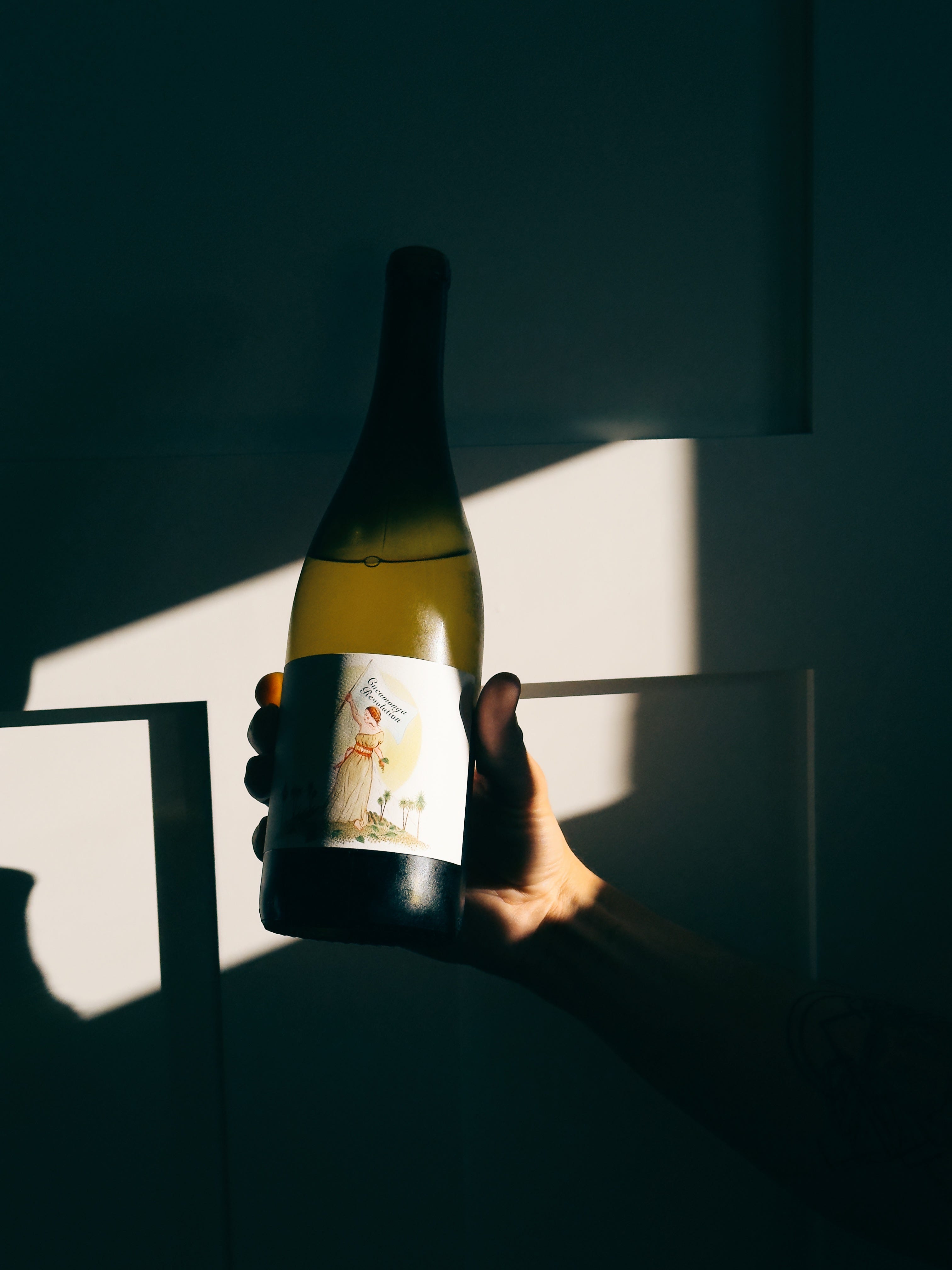
This tension between optimization and authenticity isn’t abstract for me. In fact, it’s sitting in my glass right now.
Growing up in the Mojave Desert, I knew Rancho Cucamonga as a place of strip malls and chain restaurants, hardly somewhere you'd expect to find serious winemaking. If you'd told me ten years ago that I'd one day be savoring a wine from there, let alone writing about it, I would have laughed in your face. Cucamonga and wine? Like claiming Las Vegas made great coffee. But here I am, glass in hand, confronting my own assumptions about home.
This bottle tells a story that rewrites California wine history. Before Prohibition strangled the industry, Los Angeles was the beating heart of California winemaking, producing wines from varieties like Palomino and Mission that thrived on sandy soils. The Lopez Vineyard, where these grapes grew, was planted in 1912—vines that have survived over a century without a single application of pesticides, fungicides, or even sulfur. 111 years of pure survival, sandwiched now between warehouses and highways, producing barely a kilogram of fruit per plant.
Palomino is typically dismissed as the workhorse grape of sherry production—neutral, unremarkable on its own, supposedly requiring the oxidative aging and fortification of Jerez to become interesting. Most wine professionals would tell you it makes bland table wine at best. But Raj Parr, the sommelier-turned-vigneron, saw something others missed in these ancient, neglected vines. He found these relics and recognized possibility where others saw problems. Vines so old they’d been left unpruned for years, yields so low they defied commercial logic, fruit from a grape variety no reasonable person would flag as promising material. Yet from these stubborn survivors and his skilled winemaking comes something that proves conventional wisdom wrong.
The wine pours pale gold with a slight haze—unfiltered, naturally cloudy, the way wine looked before modern technology cleaned up every imperfection. On the nose, there’s green apple and wet stone, hints of citrus peel and dried herbs. The palate is bone dry but not austere, with a weight and texture that comes from those ancient vines’ deep roots, finishing with a mineral persistence that makes you want to return to the glass immediately.
What strikes me most is how much this wine tastes like somewhere specific—not just Southern California, but this exact patch of sandy granite soil that has somehow resisted development and time. There’s a dusty minerality that speaks of hot summers and winter rains, a brightness that cuts through heat, a character that could only come from vines old enough to have their own memories.
Parr didn’t rescue these vineyards because market research suggested demand for Cucamonga Palomino. He did it because he recognized something precious that was about to disappear forever—that’s exactly the kind of beautiful contrarianism that emerges when curiosity overrules conventional wisdom.
Sometimes the most profound discoveries happen in your own backyard, in places you thought you knew too well to hold surprises. Sometimes home reveals itself differently when you’ve traveled far enough to see it fresh. This bottle is both a wine and a reminder that the most unlikely places might be hiding the most extraordinary stories.
Table Talk
Here in the U.S., Labor Day weekend arrived like a gentle reminder that summer fades gradually, then all at once. I spent those three days clinging to the season’s last gifts, setting up camp on patios and porches, chasing every excuse to eat outdoors while the air still held warmth without weight.
There’s something almost desperate about late summer dining, the way we gather these moments with cupped hands, knowing they’ll slip through our fingers soon enough. The stone fruit at the farmers market has reached that perfect point of ripeness where peaches and nectarines yield to the slightest pressure, their juice threatening to run down your chin at first bite. Tomatoes arrive heavy with sunshine, their skins tight and glossy, demanding nothing more than coarse salt and good olive oil to reveal their essence.
These are the ingredients that exist only in their moment of perfection. They are what they are for such a brief window, and then they’re gone—another reminder that the most meaningful things resist optimization, refuse to be improved upon or extended beyond their natural rhythms.
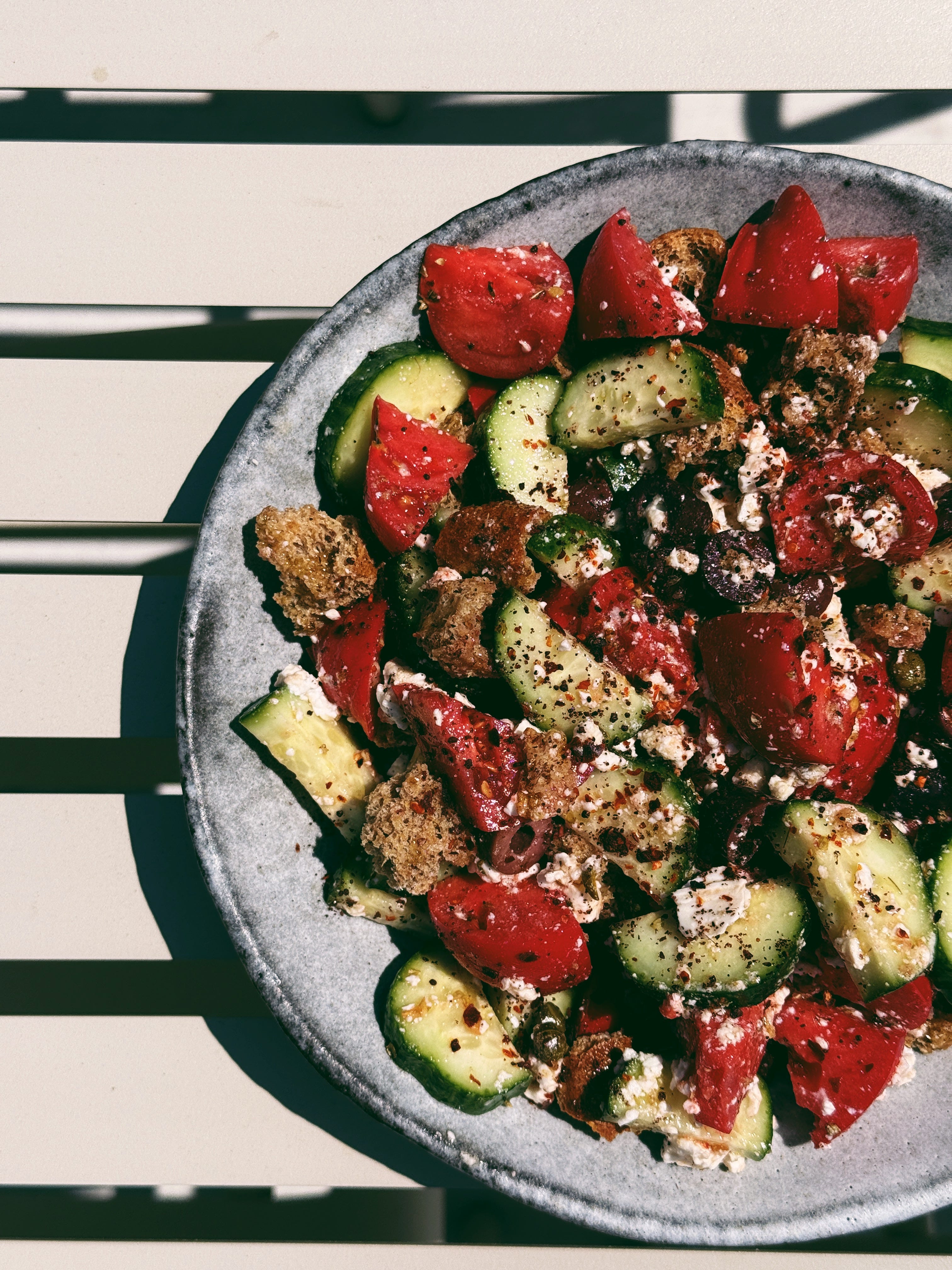
I find myself cooking less and arranging more during these final summer weeks—slicing tomatoes thick and laying them on wooden boards, tearing feta with my hands, drizzling everything with the kind of olive oil that costs too much but tastes like liquid gold. Simple compositions that celebrate the ingredients rather than transform them. Food that tastes like time and place, like the particular alchemy of soil and sun that created these flavors.
The light during these dinners has a different quality too, golden and slanted, casting everything in soft focus. Conversations stretch longer when you’re eating outdoors, punctuated by the clink of glasses and the distant hum of evening settling in. There’s no rushing when you’re dining al fresco—the meal becomes less about feeding hunger and more about marking time, celebrating the fleeting nature of perfect weather.
Next week, I’ll be in Europe, chasing summer across continents before it slips away entirely. Following the season wherever it lingers, seeking out those last balmy evenings on terraces on the Italian Riviera or sidewalk cafés in Provence. The Europeans understand this ritual better than we do stateside, this sacred pause between day and night where food and wine and conversation blend into something approaching transcendence.
But for now, here in Napa, I’m still holding summer hostage in my backyard. Still slicing tomatoes and opening bottles that deserve the open air. Still believing that if I eat enough peaches, drink enough rosé under the stars, I can somehow make the season last just a little bit longer.
Summer’s end isn’t a date on the calendar—it simply stops being summer, the way a wave doesn’t announce its arrival at the shore. Until then, the table stays set outside, the wine stays chilled and the last of the season’s bounty gets its proper tribute. In a world pushing toward algorithmic efficiency, these unoptimizable moments—the perfect tomato, the wine that tastes like nowhere else, the evening that unfolds at exactly the pace it needs—might matter most of all.
Here’s to craft over algorithms, stories over data points and everything that remains beautifully, stubbornly human.
— Nick
This is an important angle we should all be thinking about
THIS! Soulful Humanity unable to be replicated by AI. Cheers to being human for these things specifically.